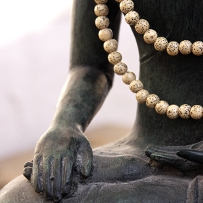
With devotional practices we choose to direct ourselves in terms of awakening. Pūjā gives the occasion to settle in our Refuge quality rather than our personal kamma. This is the way we build up a reference point to cultivate and clear the kamma of the person within the field of sangha.
The deeply ingrained reactivity to jump from unpleasant feeling is saṇkhāra. We leave the richness and intelligence of embodiment for the virtual world of programs and drives. Steadying and stabilizing the bodily energies with ānāpānasati develops a different kind of saṇkhāra, one that responds to phenomena with non-demand and acceptance.
Creating a feedback loop to keep citta refreshed and nourished strengthens our ability to meet the uncomfortable. This can’t be done through the virtual realm of the intellect; take time every day to touch into bodily presence without adjusting anything or turning away. That steady presence becomes the place of regeneration and refreshment.
Q1: ways of strengthening the citta; Q2 31:37 How can one best work with the citta? Q3 34:01 What is the relationship of intuitive awareness to the citta? Q4 36:56 Could you say something more about the sacred? Q5 40:10 greed and aversion – are they two sides of the same coin? Can one exist without the other? Q6 46:46 What is animita (signless) samādhi as opposed to nimitta samādhi or jhāna?
The habit of clinging stems from a search for safety and security, yet we cling to that which can never provide security. It’s not easy to give up clinging, so an inner strengthening is required – energetically, psychologically and emotionally.
Before reviewing the themes that present themselves to us in meditation, we need the support of safety and ground. Guidance is provided to establish center, ground and safety in this embodiment.
Phenomena that are mutable, not solid, and dependently arisen become experienced as fixed and solid by unconscious grasping and holding on. The relationship is then one of fixation. A more mature relationship is not based on eliminating displeasure but on responsiveness and flexibility. With practice one can feel comfortable with things that are uncomfortable.
Meditation practice instructs us to sustain harmonious relationship with our minds, bodies and the world – to not be dominating, not to grasp or push away, but to be present. Sometimes an open accepting awareness, rather than a focus on a particular object, is the proper mode. When mental and body energies are in sync there’s a sense of harmony and unification. This is samādhi.
Our walking gets programmed by the drives of the mind. Whatever affects the mind affects the nervous system of the body – the body shows us the effects of our thinking. Walking meditation can return us to the natural quality of the body, so the mind can relax.
The search for happiness, security and steadiness binds us in a tangle of stressful and unsatisfactory experiences – because we’re looking in the wrong place. Wisdom/discernment helps us detangle and discern what to set aside and what is worth bearing in mind.